
There are some very useful theorems that can help in evaluating Moments of Inertia.
Parallel Axis Theorem
The first is the Parallel Axis Theorem. This theorem states that if you know the MOI for rotation about one axis, then the MOI for rotation around a different but parallel axis differs by 


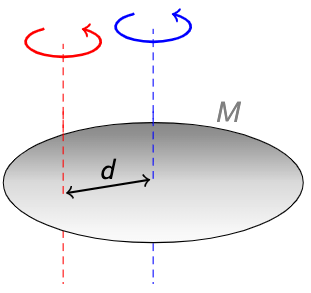
That is, if the axis 


This helps since it is often hard to calculate MOI using the integral definition, unless the axis passes through the object’s centre of mass.
Example
Consider the example of a solid sphere on the end of a rod, rotating around an axis at the end of the rod.
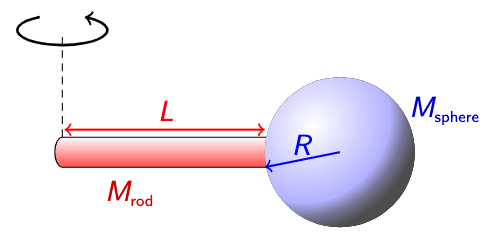
By the principle of superposition and the parallel axis theorem,

Perpendicular Axis Theorem
The second theorem is the Perpendicular Axis Theorem.
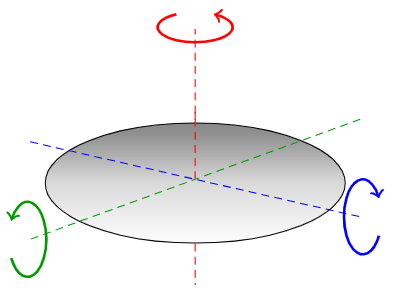
For a thin object in the 


we have


Example
Find the MOI of a disk with mass 
By the perpendicular axis theorem,

and we know that 
By symmetry 

and rearranging we get that

In the next post in this series, we will investigate using symmetry in a different way, by using the method of self-similarity to find moments of inertia.

 The Calculus of Explanations
Leave a comment