
A slightly impractical but fascinating use of the self-similarity method is finding the Moment of Inertia of certain famous fractals.
Example – The Sierpiński Triangle
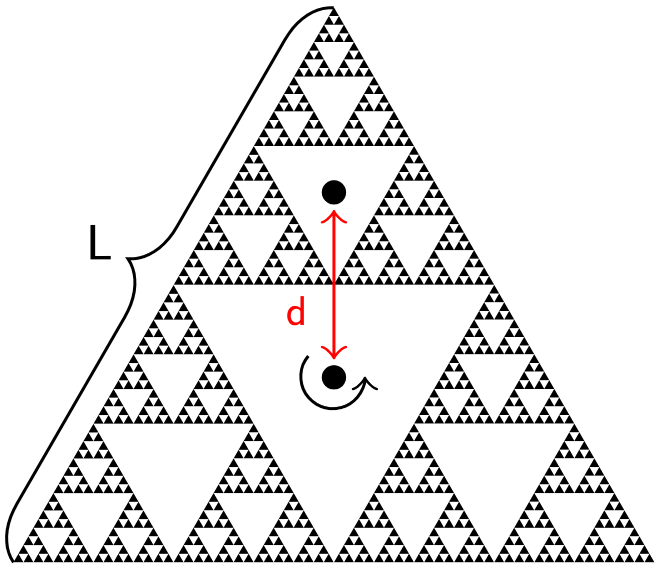
Consider that the Sierpiński triangle of mass 

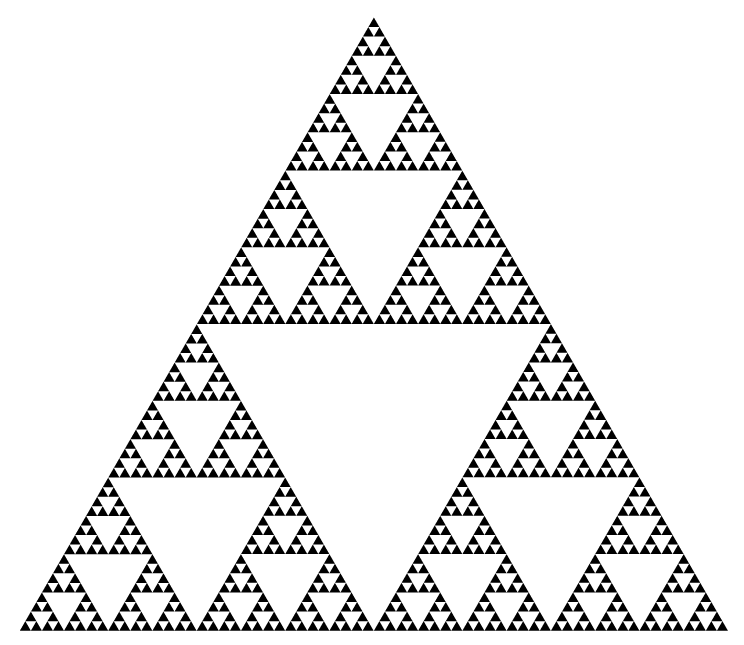
If the triangle is being rotated about its centre, we simply need to calculate 
So

Using the Parallel Axis Theorem,

where

the contribution of each small triangle is the moment of inertia through its centre of mass (COM) plus its mass multiplied by the distance to the axis of rotation squared. This distance is 

With which we reach the final result

Note that the moment of inertia is larger than the MOI of an equilateral triangle with equivalent mass, which was 

 The Calculus of Explanations
Leave a comment