
-
Moments of Inertia – Part II
The extent to which an object resists rotational acceleration about a particular axis is captured by a quantity called Moment of Inertia. Continue reading
-
Moments of Inertia – Part I
When I used to teach maths to mechanical engineers, one lecture I used to particularly enjoy was related to Moment of Inertia, the property of a body that measures its ability to resist changes to its angular velocity. Continue reading
-
The lie at the heart of the Eiffel Tower
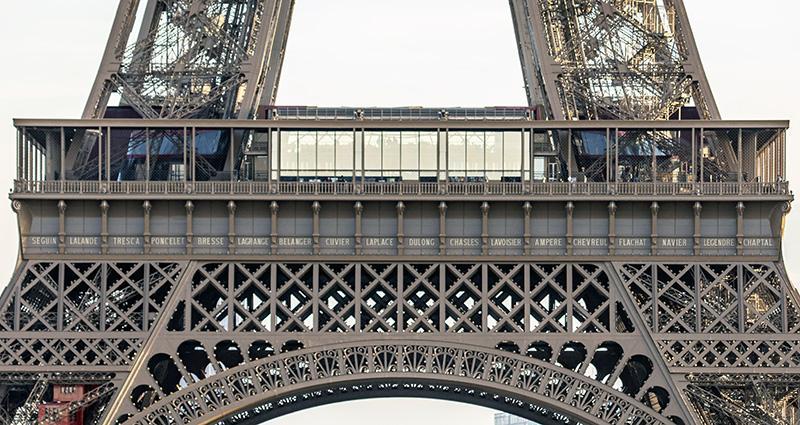
This is a bit of a departure from the usual content of this blog, more a musing on an odd bit of trivia regarding mathematical history, nation building, and an iconic landmark at the heart of one of the world’s most famous cities. Named after Gustave Eiffel – his company completed the tower in 1889… Continue reading
-
the earth is actually a donut: part ii
In our previous post we figured out how much of a donut planet had the planet directly overhead. This was done for the regime in which the major radius was larger than the smaller radius . What about the case when , called a “spindle” torus? When the circles intersect, they do so at ,… Continue reading
-
the earth is actually a donut: part i
I recently saw this meme. Below is a transcript of my thoughts. As usual, a shoutout to my coauthor D.G. for his contributions to the calculations. First thought: …that’s silly Second thought: Most of the Earth couldn’t see the ocean above them, so that can’t possibly be the reason. Third thought: Actually, I wonder how… Continue reading
-
The longest arc: Part II
Last time we saw that the problem of finding the circle with the longest arc-length wasn’t possible analytically, and we had to resort to numerical or graphical methods. Now we extend the problem to find the sphere centered at the origin with the largest surface area inside a unit sphere shifted vertically by one unit.… Continue reading
-
The longest arc: Part I
Another great problem I saw on Facebook – picture a unit circle (radius ) centred at . Which circle centred at the origin has the largest arc-length inside the unit circle? Consider a unit circle centred at , and a generic circle centred at the origin of radius , . Since the first expands to… Continue reading
-
The largest area: Part III
In Part II of this series, we wondered whether the result of the area being constant continued into higher dimensions, but, assuming it does, we also wondered whether there was any logic to the sequence of the actual value of these constant volumes. A reminder that we currently have This bugged me for a little… Continue reading
-
The largest area: Part II
Here we will consider the 3D analogue of the problem mentioned in the previous post, and first define the two paraboloids (the 3D analogue of parabolas): This time we’ll call the tangent point . Then the slope of the tangent plane of at in each direction is given by the partial derivatives of : And… Continue reading
-
The largest area: Part I
This adventure started when I attempted a harmless looking problem from the Facebook group “Actually Good Maths Problems”. The answer, which any motivated high school calculus student could find, is a sort of joke or prank on the solver, and I enjoyed it enough that I sent the problem to my good friend David Galea.… Continue reading
-
A journey into Circle Inversion
A few years ago I watched the brilliant Numberphile video with Simon Pampena about using circle inversion to solve a problem involving Pappus’ chains, also known as Appolonian gaskets. Although the presentation was compelling and the problem interesting, it was a bit complicated and long for a first introduction to the topic. I started playing… Continue reading
-
Moments of Inertia – Part V
A slightly impractical but fascinating use of the self-similarity method is finding the Moment of Inertia of certain famous fractals. Example – The Sierpiński Triangle Consider that the Sierpiński triangle of mass and side length is comprised of three smaller copies of itself. If the triangle is being rotated about its centre, we simply need to calculate… Continue reading
-
Moments of Inertia – Part IV
In this post, we explore the method of self-similarity for calculating Moments of Inertia. Continue reading
-
Moments of Inertia – Part III
There are some very useful theorems that can help in evaluating Moments of Inertia. Continue reading
-
The Four Mice Problem
Four mice are initially sitting at the corners of a unit square. At the same time, each of the mice begin running with equal speed directly toward the mouse on their right. How far do the mice travel? Continue reading
Hi there! I’m a content creator with a background in maths education and a passion for making complicated ideas simple, with intuitive animations and visual explanations.
Whether you’re just entering high school or you’re a post-grad student, or just have an interest in maths in general, I aim to make content that can appeal to everyone, in the form of videos and blog posts.
You can find all my previous posts here.
Check out my YouTube channel for more maths education content.
 The Calculus of Explanations