
This adventure started when I attempted a harmless looking problem from the Facebook group “Actually Good Maths Problems”. The answer, which any motivated high school calculus student could find, is a sort of joke or prank on the solver, and I enjoyed it enough that I sent the problem to my good friend David Galea.
I thought that would be the end of it.
But then, as mathematicians often do, we started asking each other questions. This lead us down a rabbit hole as the problem morphed into an intriguing riddle with surprising results, which we still haven’t fully understood.
Let’s get into it.
Draw two parabolas, 


The problem is to find the tangent point that maximises this area, and to find that maximal area.
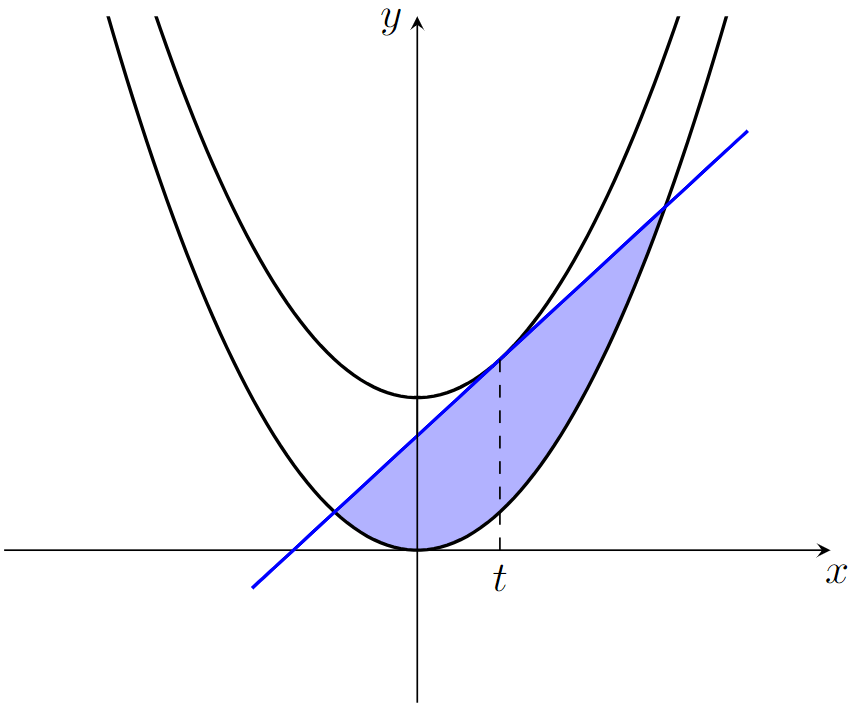
Noting that the derivative for the curve 


or, simplifying,

The area between this tangent and the lower parabola is now a function of this parameter 

where 


This is a quadratic, with the solutions 


Now, we have an expression for 


It’s not too hard to show that 

Thus we have the fact that 
If we let 

So we have our answer. The area is the same no matter where we place the tangent, and it’s 
As I said, a mildly amusing result. Don’t believe it? Try it here, drag the tangent point and see the area remain the same.
The next chapter in the story was David and I wondering whether the area was also constant when we generalise the problem to higher dimensions.
What we found was extremely surprising, I hope you’ll join us to explore this problem further in the next post.
Stay curious!


 The Calculus of Explanations
Leave a comment