
Here we will consider the 3D analogue of the problem mentioned in the previous post, and first define the two paraboloids (the 3D analogue of parabolas):

This time we’ll call the tangent point 


And so the equation for the tangent plane 


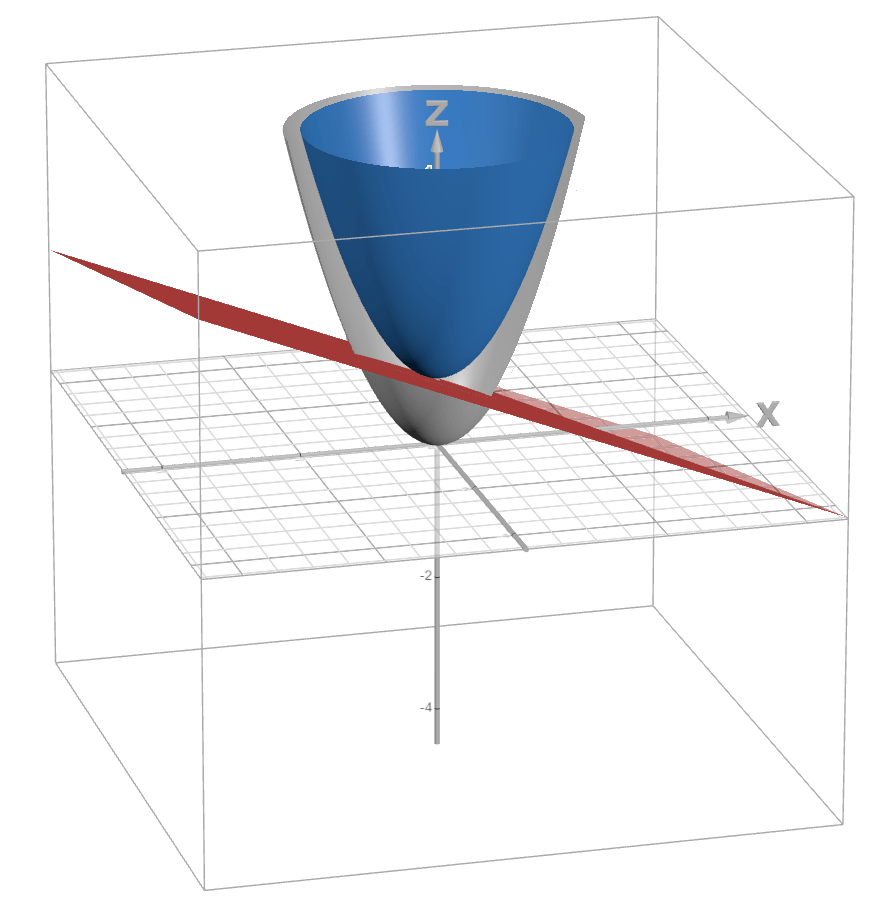
Play around with the sliders here to see the tangent plane and the associated volume underneath change shape (Note that I had to strategically cut the outer paraboloid so we can see what’s going on).
If you solve for the region of intersection between 


From here, we can define the volume 

We now introduce a change of variables 


We first note that

a common trick from multivariable calculus. Then we have
![\begin{aligned} V &= \iint_{R'} \displaystyle \left(1 - u^2 - v^2\right) \mathrm{d}R' \\ &= \displaystyle \int_{-\pi}^{\pi} \int_0^1 \left(1 - r^2\right) r \, \mathrm{d}r \, \mathrm{d}\theta \\ &= \displaystyle \int_{-\pi}^{\pi} 1 \, \mathrm{d}\theta \int_0^1 \left(1 - r^2\right) r \, \mathrm{d}r \\ &= \left[\theta\right]_{-\pi}^{\pi} \left[\frac{r^2}{2} - \frac{r^4}{4}\right]_0^1 \\ &= 2\pi \cdot \frac{1}{4} \\ V& = \frac{\pi}{2} \end{aligned}](https://s0.wp.com/latex.php?latex=%5Cbegin%7Baligned%7D+V+%26%3D+%5Ciint_%7BR%27%7D+%5Cdisplaystyle+%5Cleft%281+-+u%5E2+-+v%5E2%5Cright%29+%5Cmathrm%7Bd%7DR%27+%5C%5C+%26%3D+%5Cdisplaystyle+%5Cint_%7B-%5Cpi%7D%5E%7B%5Cpi%7D+%5Cint_0%5E1+%5Cleft%281+-+r%5E2%5Cright%29+r+%5C%2C+%5Cmathrm%7Bd%7Dr+%5C%2C+%5Cmathrm%7Bd%7D%5Ctheta+%5C%5C+%26%3D+%5Cdisplaystyle+%5Cint_%7B-%5Cpi%7D%5E%7B%5Cpi%7D+1+%5C%2C+%5Cmathrm%7Bd%7D%5Ctheta+%5Cint_0%5E1+%5Cleft%281+-+r%5E2%5Cright%29+r+%5C%2C+%5Cmathrm%7Bd%7Dr+%5C%5C+%26%3D+%5Cleft%5B%5Ctheta%5Cright%5D_%7B-%5Cpi%7D%5E%7B%5Cpi%7D+%5Cleft%5B%5Cfrac%7Br%5E2%7D%7B2%7D+-+%5Cfrac%7Br%5E4%7D%7B4%7D%5Cright%5D_0%5E1+%5C%5C+%26%3D+2%5Cpi+%5Ccdot+%5Cfrac%7B1%7D%7B4%7D+%5C%5C+V%26+%3D+%5Cfrac%7B%5Cpi%7D%7B2%7D+%5Cend%7Baligned%7D+&bg=ffffff&fg=000&s=1&c=20201002)
So just like the base case with the parabolas, in this case the volume is a constant. Is this true in all higher dimensions, for all possible 
This in itself is pretty cool, but something that really stood out to us was the pattern of values themselves. If we call the area, volume or hyper-volume under the tangent in 


Can you guess the next value in the series?
Even though we only have two terms, they strongly reminded me of something I read about as an undergrad, and David was able to provide the calculations to prove the conjecture!
See the third and final post in this series to see the conclusion to the story, it’ll be a ball, I promise.
Stay curious!


 The Calculus of Explanations
Leave a comment