
Last time we saw that the problem of finding the circle with the longest arc-length wasn’t possible analytically, and we had to resort to numerical or graphical methods.
Now we extend the problem to find the sphere centered at the origin with the largest surface area inside a unit sphere shifted vertically by one unit.
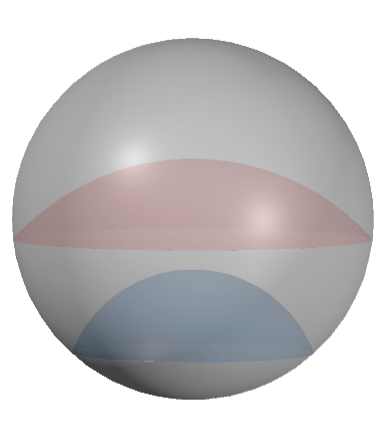
Here we define a sphere (


And the ‘expanding’ sphere (


Where 

Setting the right hand sides equal gives us that 
To identify the region this corresponds to in 


Here we observe that 

We first observe that the radius of the expanding sphere is 


Recall for

Similarly, we have 

This integral is crying out for a substitution, into the polar coordinates given by 

![\begin{aligned}\displaystyle A\left(\rho\right) &= \displaystyle \rho^2\int_{-\pi}^{\pi}\:\mathrm{d}\theta \int_{0}^{\frac{\sqrt{4 - \rho^2}}{2}} \frac{r}{\sqrt{1 - r^2}}\:\mathrm{d}r \\ &=\rho^2\left[ \theta\right]_{-\pi}^{\pi} \left[-\sqrt{1 - r^2} \right]_0^{\frac{\sqrt{4 - \rho^2}}{2}} \\ &= \rho^2 \cdot 2\pi \left(1 - \sqrt{1 - \left(\frac{\sqrt{4 - \rho^2}}{2}\right)^2}\right)\\ &= 2\pi\rho^2 \left(1 - \frac{\rho}{2}\right) \\ A\left(\rho\right) & = 2\pi\left(\rho^2 - \frac{\rho^3}{2}\right) \end{aligned}](https://s0.wp.com/latex.php?latex=%5Cbegin%7Baligned%7D%5Cdisplaystyle+A%5Cleft%28%5Crho%5Cright%29+%26%3D+%5Cdisplaystyle+%5Crho%5E2%5Cint_%7B-%5Cpi%7D%5E%7B%5Cpi%7D%5C%3A%5Cmathrm%7Bd%7D%5Ctheta+%5Cint_%7B0%7D%5E%7B%5Cfrac%7B%5Csqrt%7B4+-+%5Crho%5E2%7D%7D%7B2%7D%7D+%5Cfrac%7Br%7D%7B%5Csqrt%7B1+-+r%5E2%7D%7D%5C%3A%5Cmathrm%7Bd%7Dr+%5C%5C+%26%3D%5Crho%5E2%5Cleft%5B+%5Ctheta%5Cright%5D_%7B-%5Cpi%7D%5E%7B%5Cpi%7D+%5Cleft%5B-%5Csqrt%7B1+-+r%5E2%7D+%5Cright%5D_0%5E%7B%5Cfrac%7B%5Csqrt%7B4+-+%5Crho%5E2%7D%7D%7B2%7D%7D+%5C%5C+%26%3D+%5Crho%5E2+%5Ccdot+2%5Cpi+%5Cleft%281+-+%5Csqrt%7B1+-+%5Cleft%28%5Cfrac%7B%5Csqrt%7B4+-+%5Crho%5E2%7D%7D%7B2%7D%5Cright%29%5E2%7D%5Cright%29%5C%5C+%26%3D+2%5Cpi%5Crho%5E2+%5Cleft%281+-+%5Cfrac%7B%5Crho%7D%7B2%7D%5Cright%29+%5C%5C+A%5Cleft%28%5Crho%5Cright%29++%26+%3D+2%5Cpi%5Cleft%28%5Crho%5E2+-+%5Cfrac%7B%5Crho%5E3%7D%7B2%7D%5Cright%29+%5Cend%7Baligned%7D&bg=ffffff&fg=000&s=0&c=20201002)
A remarkably simple formula for the surface area of the expanding sphere!
To find the one with the maximum surface area, we take the derivative and set it equal to zero,

This equation has two solutions; 

If we put this value back into our surface area formula we get that the maximum area is

As we mentioned in the previous post, this seems to be a problem that (in some sense) becomes easier in one higher dimension.
However you feel about double integrals aside, it is interesting that in the case of the circles, the equation to solve for the optimal radius was analytically intractable, whereas for spheres, it is a simple quadratic.
This allows us to achieve a closed form solution for the maximum area in 3d, something that wasn’t possible in 2d.
Actually, we think that 


Interestingly, this seems to be true for different reasons depending on whether the dimension
But that’s a story for next time.
Stay curious.


Leave a Reply